
How to Choose Living Room Furniture for a Coastal Home
Coastal Living Guide · Jacó, Costa Rica
How to Choose Living Room Furniture for a Coastal Home.
Style, durability, and humidity resistance for tropical living rooms in Costa Rica.
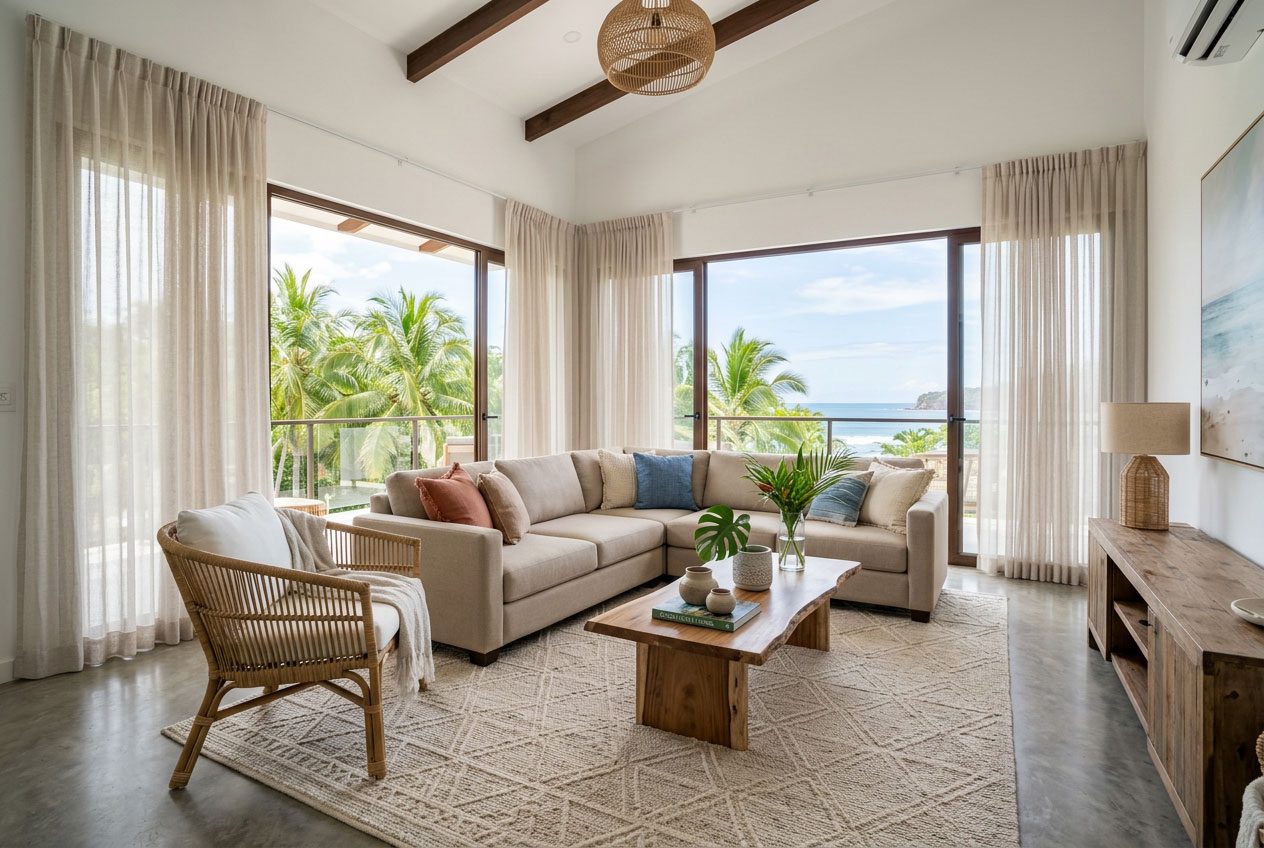
Furnishing a coastal living room in Costa Rica is a different challenge than decorating a home in a temperate climate. The Pacific coast brings breathtaking beauty — and with it, relentless heat, salt air, and humidity levels that can hover above 80% for months at a time. The furniture you choose needs to perform in those conditions while still making your living room feel like the retreat you envisioned.
Whether you’re an expat settling into a home in Jacó or Tamarindo, a condo owner in Guanacaste, or a vacation rental operator who needs pieces that look great in photos and survive heavy guest turnover, the principles are the same: prioritize materials that resist moisture and mold, choose silhouettes that breathe, and build a layout that connects your indoor space to the outdoor views that make coastal living worth it.
Furnishing a living room for coastal conditions? Send us a photo of the space — we’ll help you get the materials right.
Ask Us 📲Understanding the Coastal Environment.
Humidity
The most persistent challenge. Even in dry season, coastal homes rarely drop below 60–70% relative humidity. During rainy season — May through November — interiors can sit above 85% for weeks. This warps solid wood, breeds mold in dense foam, corrodes metal hardware, and degrades cheap fabric at the seams.
Salt Air
Compounds the problem near the beach. Salt accelerates corrosion on metal frames and hardware, and can degrade certain synthetic fabrics through surface crystallization over time.
Heat & UV Exposure
Matters especially in open-plan homes with large windows or indoor-outdoor transitions. Direct sun fades upholstery, dries out natural fibers, and can crack leather that isn’t properly conditioned for tropical climates.
Good News
The right materials handle all of this gracefully — and they tend to look beautiful doing it. Tropical-climate design has a rich visual language that aligns naturally with the materials that perform best here.
Material Matters Most.
The sofa is typically the largest investment in any living room, and in a coastal home, material selection is everything.
Frame Materials
Teak frames sourced from established workshops in Southeast Asia — Indonesia, Thailand, and the Philippines — are built for exactly this kind of climate by design, not coincidence. Riviera’s imported Asian furniture collections bring that heritage directly to the Central Pacific, with pieces that have proven themselves in tropical conditions for generations.
Cushion Fill & Fabric
Even the most durable frame becomes a problem if the cushions are made from standard interior foam. In a coastal home, cushion fill should be quick-dry foam — either open-cell foam designed for outdoor use or polyester fiberfill wrapped in a mold-resistant liner. These materials allow moisture to escape rather than trapping it inside.
For upholstery fabric, solution-dyed acrylic (Sunbrella and similar performance fabrics) is the go-to choice for tropical living rooms. The color is baked into the fiber rather than surface-applied, so UV doesn’t fade it, and the weave resists mold without becoming stuffy. It also cleans easily — a critical feature in vacation rentals or homes with children.
Avoid
Natural cotton or linen upholstery in beachfront homes. These fabrics absorb moisture readily and can develop mildew in as little as a few weeks during the rainy season, even with good airflow.
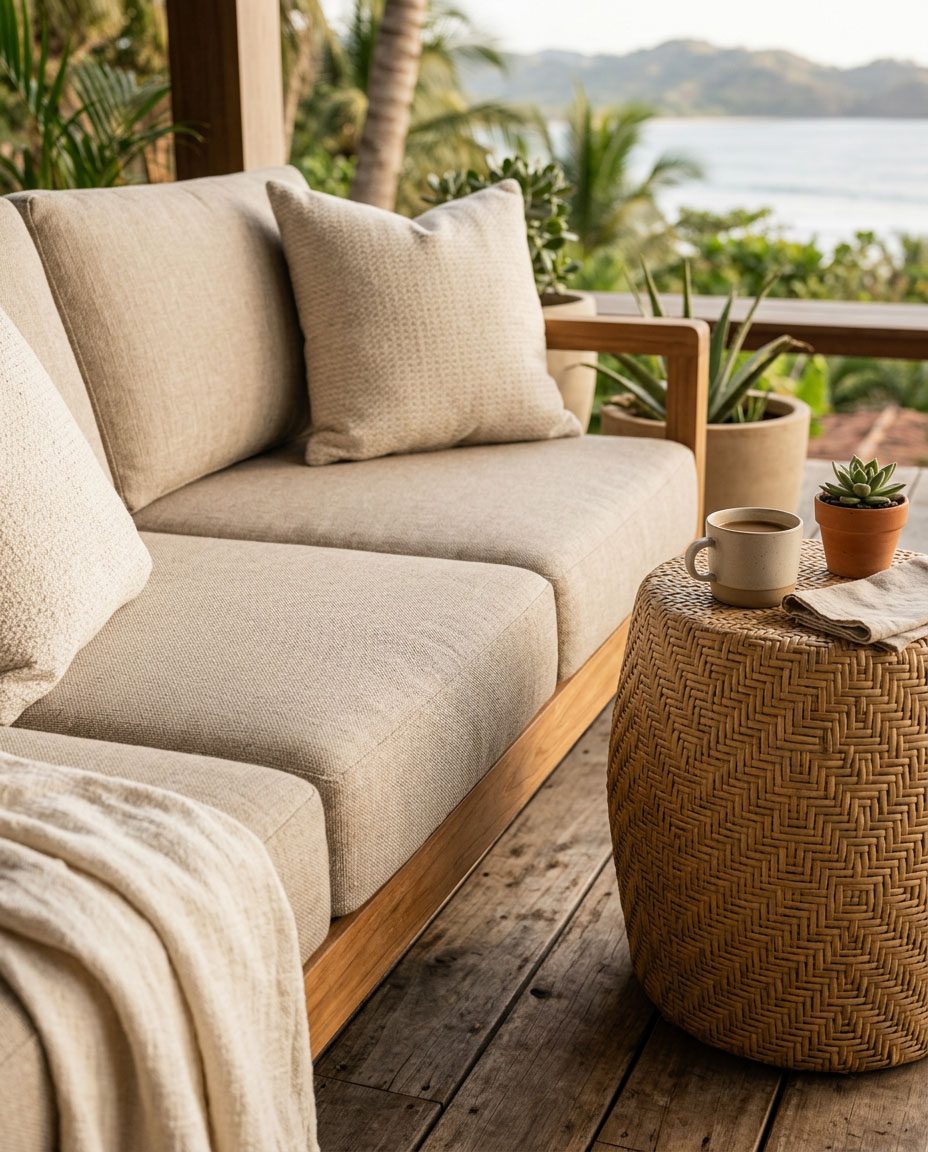
Performance fabric, up close — the difference between a sofa that lasts and one that doesn’t
Not sure if a fabric you’re considering is coastal-rated? Send us the details and we’ll tell you straight.
WhatsApp Us 📲Style Considerations
Coastal living rooms breathe best with clean, generous silhouettes — low-profile sofas, wide armrests, and deep seats that invite relaxed, informal use. Neutral base tones (sand, warm white, soft charcoal) work beautifully against the tropical landscape visible through your windows, with bolder color introduced through cushions and accessories that are easy to swap seasonally.
Rattan and natural-weave frames are perennially appealing in tropical interiors, but real rattan should be reserved for covered or well-ventilated spaces. Synthetic resin wicker offers the same look with dramatically better humidity resistance and is the smarter choice for most coastal living rooms.
Grounding the Space Without Trapping Moisture.
A well-chosen rug anchors the seating area and does a great deal of design work in tying a coastal living room together. In a humid climate, however, a poorly chosen rug becomes a mold incubator within a season.
Avoid
Thick wool rugs and high-pile carpets in any coastal home. They retain moisture, take days to dry, and are extraordinarily difficult to remediate when mildew takes hold.
Rug Sizing & Placement
In an open-plan coastal living room, a generously sized rug — large enough that all the main seating sits either fully on it or with just the front legs on it — reads as deliberate and grounded. A rug that’s too small makes even beautiful furniture look adrift.
Use a breathable rug pad underneath: open-weave felt or rubber-backed pads with ventilation holes allow air to circulate beneath the rug, discouraging moisture buildup against the floor.
Tips for Coastal Living Rooms.
The layout of a coastal living room should do two things simultaneously: create a comfortable, functional conversation area and make the most of whatever view or connection to the outdoors you have.
Orient Toward the View
Centering the layout on a TV wall is worth resisting as the primary orientation. Consider angling the seating toward windows, sliding doors, or a terrace, and placing the TV on an adjacent wall or in a cabinet that closes when not in use.
Create Zones in Larger Rooms
Many coastal homes have generous living areas that can accommodate more than one seating cluster. A main conversation group plus a secondary reading or lounge zone near the window gives the space depth and feels curated rather than sparse.
Allow for Air Circulation
In naturally ventilated homes, furniture placement shouldn’t block the primary airflow path between doors and windows. Leave at least 18 inches between the sofa and coffee table, and between furniture groupings and any doorways that open outside.
Go Low and Light
Low-profile furniture makes a coastal living room feel airy and connected to the landscape. Pieces with visible legs allow light to pass underneath, making the room feel larger. Glass or stone coffee tables reflect light rather than absorbing it.
Consider Indoor-Outdoor Continuity
If your living room opens onto a covered terrace or rancho, choose furniture with materials and a palette that carry through to the outdoor space. A cohesive visual flow between inside and out makes both spaces feel larger and more intentional.
Finding the Right Balance.
One of the real advantages of furnishing a home in Costa Rica is access to both worlds: skilled local artisans who can build custom pieces to your exact specifications, and importers who bring in curated furniture from major producing regions in Asia, where tropical-climate construction is standard practice.
Custom-built furniture from local Costa Rican craftspeople offers the advantage of perfect fit, material transparency, and direct collaboration on design. A locally made teak or certified hardwood sofa base, fitted with performance fabric cushions, can be a genuinely exceptional piece — and it supports the local economy in the process. See How to Spot Well-Made Furniture for what to check before you commit.
Imported collections — particularly from Bali, Java, and the Philippines — bring design sophistication and consistency that is especially valuable for vacation rental properties or when you need matching pieces across multiple units. Riviera’s showroom in the Central Pacific region curates exactly this kind of imported collection alongside locally custom-built options, so clients can find the right balance for their space and budget. For where to actually find these pieces, Where to Buy Furniture in Jacó, Costa Rica maps out the local landscape.
Pro Tip
The best coastal living rooms often blend both worlds: a landmark imported sofa or accent chair that anchors the space, paired with custom side tables or shelving built locally to fit the room precisely.
Quick Reference Checklist
- Frame is teak, marine aluminum, powder-coated steel, or sealed hardwood
- Cushions filled with quick-dry or open-cell foam
- Upholstery is solution-dyed acrylic or another performance textile
- Metal hardware is stainless, brass, or powder-coated — not bare iron or chrome
- Rug material is polypropylene or moisture-resistant natural fiber
- Rug pad is open-weave to allow airflow beneath
- Layout allows primary airflow between doors and windows
- Seating oriented toward the view, not just the TV wall
Looking for curated coastal furniture in Costa Rica? Riviera offers imported Asian furniture collections and locally custom-built pieces selected for tropical durability and coastal style. It’s the same climate-first thinking behind Sun-Kissed Serenity.
Ready to find the right pieces for your living room? Come visit us — or start the conversation right here.
Start the Conversation 📲Come See Us in Jacó 🌿
Coastal-Rated Furniture. See It in Person.
No appointment needed. Come as you are.
Two floors of imported collections and custom-made pieces, selected for tropical durability and coastal style.
Centro Comercial Plaza Boulevard
Calle Ancha, Locals #14, #15 & #16
Jacó, Costa Rica
📲 +506 6047-3326 (WhatsApp)